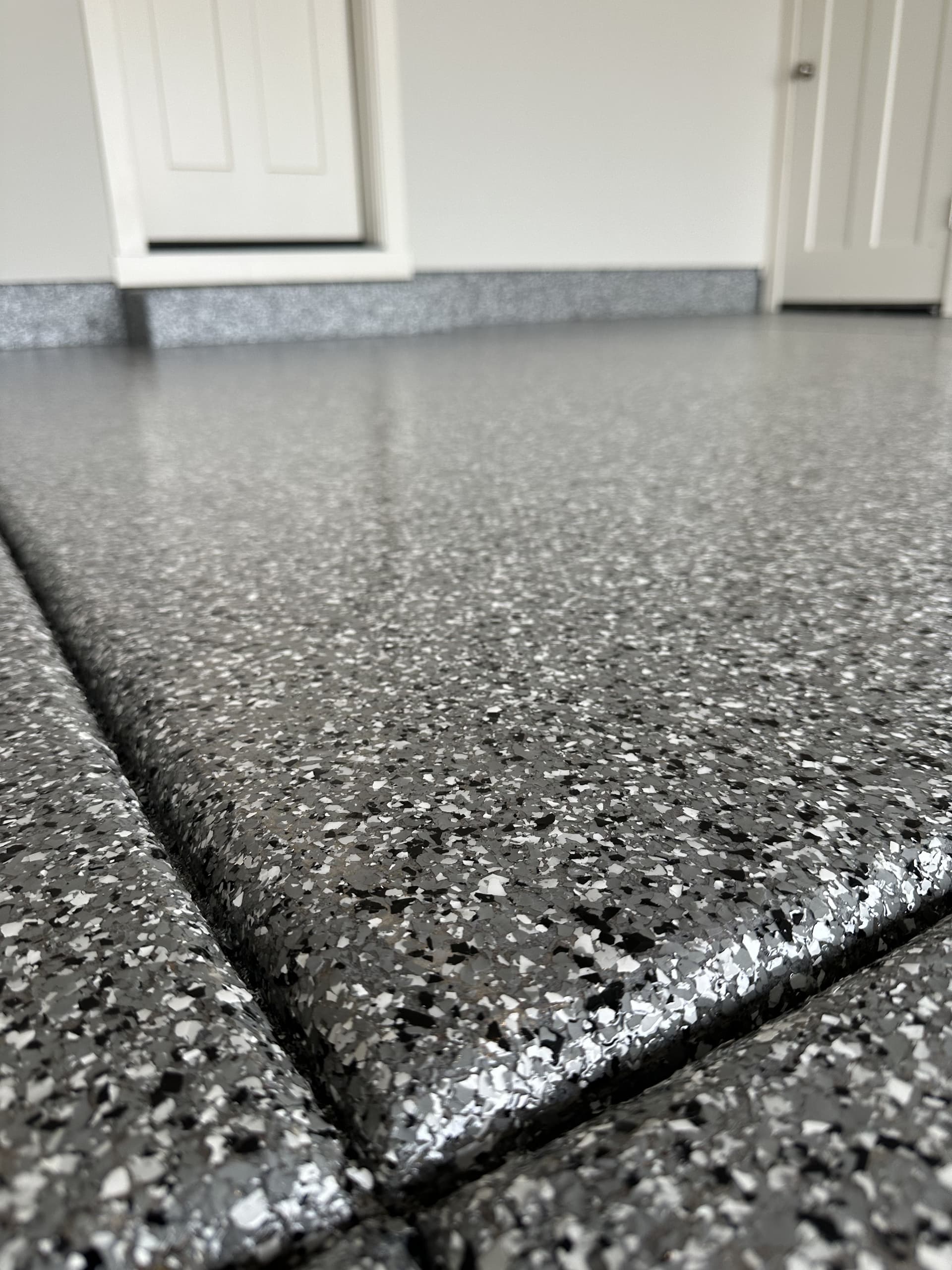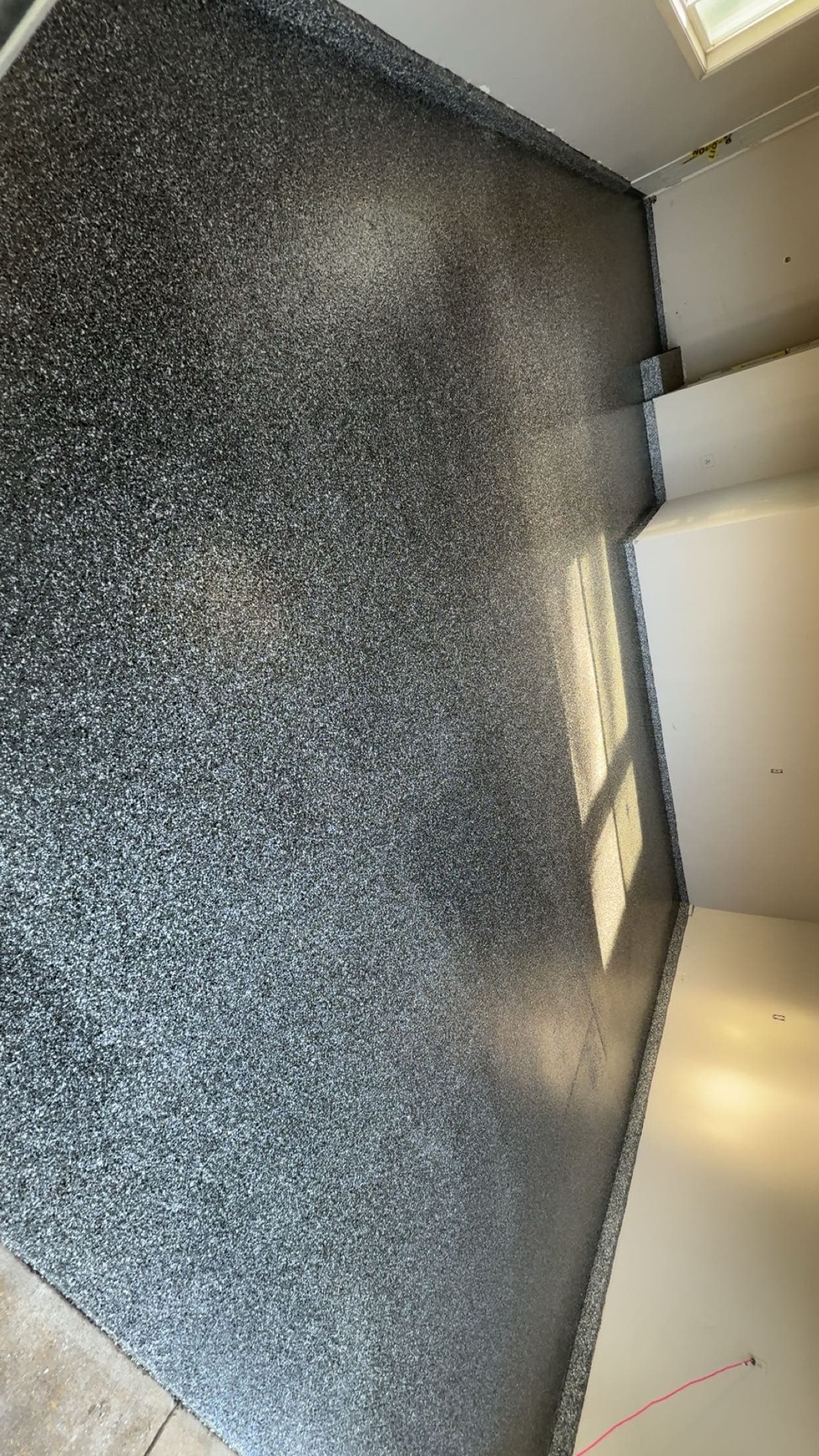

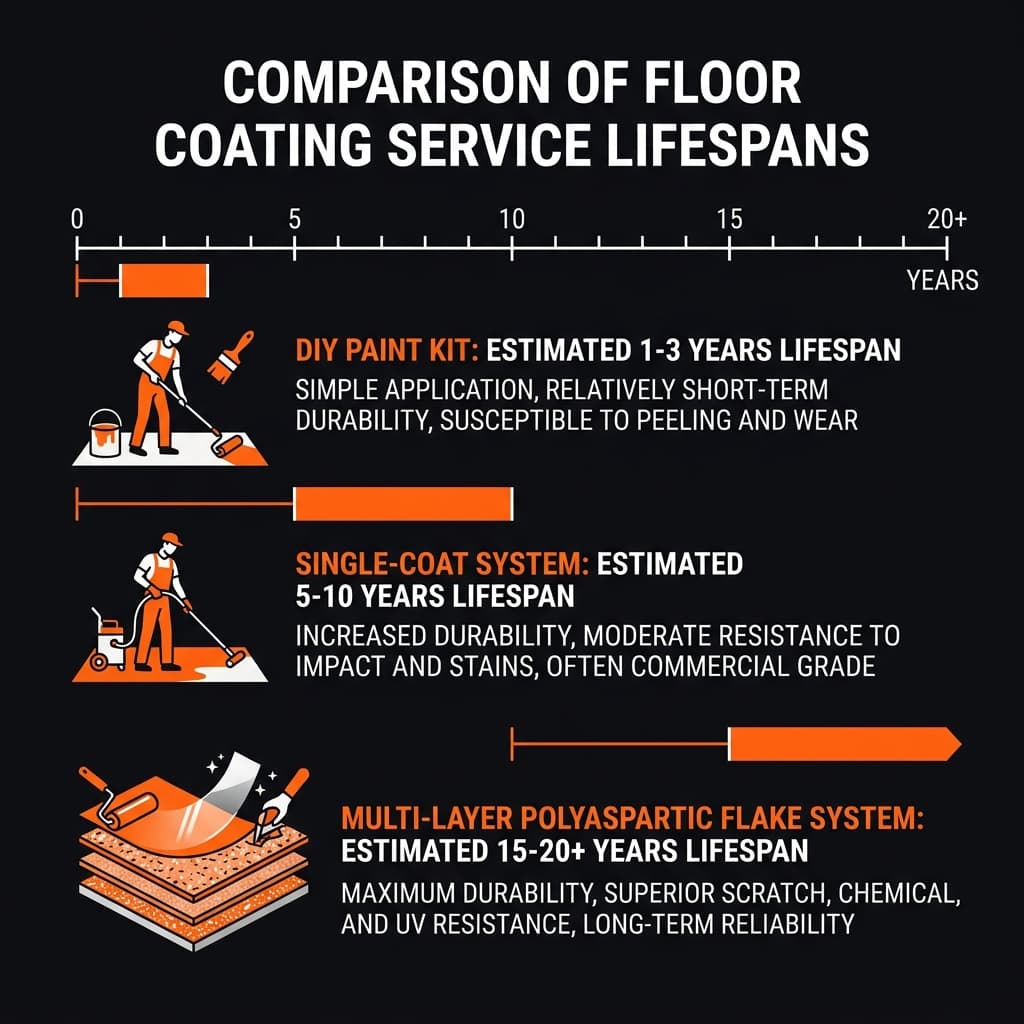
A professionally installed epoxy basecoat with full flake broadcast and a polyaspartic topcoat lasts 15 to 20+ years in a residential garage. DIY roll-on kits typically fail within 1 to 3 years due to inadequate surface prep and thin film build.
The Short Answer, by System Type
Big-box DIY roll-on kit: 1 to 5 years. Visible wear commonly appears within the first 1 to 3 years, and peeling sometimes starts inside the first year.
Professionally installed single-coat epoxy: roughly 5 to 10 years in a residential garage.
Professionally installed epoxy basecoat with full flake broadcast and a polyaspartic topcoat: 15 to 20 years or more, with well-maintained floors running past that.
Commercial and industrial floors: highly dependent on load. A warehouse under constant forklift traffic and a retail showroom with foot traffic only are not the same question.
The important point is buried in those numbers. The same resin appears in the 3-year outcome and the 20-year outcome. Lifespan is not something the product has. It is something the installation produces. Five variables decide it.
Variable 1: Surface Preparation
The large majority of coating failures trace back to this one variable, and it is the one most often shortcut because it is invisible in the finished floor.
The industry standard is ICRI Guideline 310.2, which defines nine Concrete Surface Profiles from CSP 1, essentially unaltered, to CSP 9, heavily exposed aggregate. The profile is not arbitrary. Thin coatings between about 4 and 15 mils bond correctly to CSP 2 to 3. Higher-build systems from roughly 15 to 40 mils need CSP 3 to 4. Too smooth and there is nothing for the resin to key into. Too aggressive and the coating cannot fill the profile.
This is why acid etching, the method every DIY kit ships with, is not adequate. Etching cannot reliably produce a CSP 2 profile. It bites unevenly across a slab, leaves chemical residue that must be neutralized and rinsed, and drives water into the concrete right before you seal it. Every one of those is a bond risk.
Industrial diamond grinding removes the weak surface laitance layer, opens the pore structure mechanically, and produces a consistent measurable profile across the entire slab. It is also the only method that reliably removes previous coatings and contamination. The full process is documented in our guide on concrete moisture testing and surface grinding.
Variable 2: Moisture, and Why Oregon Slabs Are Different
Concrete is a wick. Ground moisture enters the slab from below and vapor migrates upward continuously. Seal that vapor under an impermeable coating and the pressure has nowhere to go. It collects at the bond line and lifts the coating in blisters, or delaminates it in sheets.
The failure has a cruel timing profile. The floor looks perfect through installation and often through the first year. Bubbles appear in year two or three. By then the DIY kit receipt is long gone and the discount contractor is not answering.
Two ASTM standards govern this. ASTM F1869 is the anhydrous calcium chloride test, which measures moisture vapor emission rate at the surface over 24 to 72 hours. ASTM F2170 uses in-situ relative humidity probes drilled to 40 percent of slab depth, reading the internal moisture equilibrium rather than just the surface condition. F2170 is more predictive of long-term behavior, and a growing number of manufacturers now require it for warranty coverage.
Now the local part. The Willamette Valley holds persistent fog and saturated soil from November through February, and winter rain drives capillary rise through porous slabs for months at a stretch. Many older Oregon garage slabs were poured with no vapor barrier underneath at all. This is not a hypothetical risk here. It is the default condition, and it is why we run electronic moisture testing on every job before quoting a system. If the readings call for it, a vapor barrier primer goes down first. Skipping that step to save a few hundred dollars is how you buy a floor twice.
Variable 3: Film Thickness
Coating thickness is measured in mils. One mil is one thousandth of an inch. It is the least glamorous number in a proposal and one of the most predictive.
A big-box roll-on kit typically cures somewhere around 3 to 5 mils. Much of that thickness is water or solvent that evaporates, so the film you rolled on is not the film you keep. A professional residential system runs 14 to 20 mils or more of total build across primer, basecoat, and topcoat. Full broadcast flake systems build higher still, because the chip layer itself contributes to thickness, which is one of the practical reasons to weigh flake against a solid color finish.
The relationship between thickness and lifespan is not linear, and this is the part worth understanding. Abrasion removes a roughly consistent amount of material per year for a given traffic level. Failure is a threshold event: the floor is fine until wear reaches the substrate, then it fails quickly. Doubling the film build more than doubles the service life, because you are not just adding material, you are pushing the threshold further out past the point where other degradation mechanisms would have gotten there first.
It also explains why the same product performs so differently in different hands. A contractor spreading material thin to make a low bid work is selling you the same resin at a fraction of the service life. Our full broadcast flake system is specified by build, not by coats.
Variable 4: Topcoat Chemistry
What sits on top determines what the floor is fighting, because the topcoat is the only layer actually exposed to UV, abrasion, chemicals, and tire heat.
An epoxy topcoat will amber under ultraviolet light. Every epoxy does, because the aromatic backbone absorbs UV and degrades. In a garage this typically means a yellowed band in the first few feet inside the door within a few years. A polyaspartic topcoat is aliphatic and holds color indefinitely. Polyaspartic also outperforms epoxy on abrasion resistance and stays flexible enough to move with a slab through seasonal expansion and contraction, where rigid cured epoxy is more prone to cracking.
The floor with the epoxy topcoat has not failed structurally at year seven. It just looks tired, two-tone, and dull, and most people replace it for that reason alone. Cosmetic lifespan and structural lifespan are different numbers, and the topcoat sets the shorter one. The full chemistry comparison is in our guide on polyaspartic vs. epoxy garage floors.
Variable 5: What You Actually Do on the Floor
Hot tire pickup is the most common use-related failure. Tires heat, expand, grip the coating, then contract as they cool and pull the film off any area where the bond or the build is inadequate.
Point loading does damage out of proportion to its size. Jack stands, floor jack wheels, motorcycle kickstands, and heavy shelving feet concentrate weight into a very small contact area. Steel jack wheels dragged across a floor are a common source of gouging.
Winter chemistry is an Oregon-specific stressor. Road deicers and magnesium chloride ride into the garage in wheel wells and dissolve onto the slab as snow melts off the vehicle. Left to sit, they attack the coating and any exposed concrete at joints and edges.
Automotive fluids vary in aggression. A quality polyaspartic topcoat handles motor oil, gasoline, antifreeze, and brake cleaner without staining if wiped up in reasonable time. Battery acid and prolonged brake fluid contact are harsher, and both should be cleaned up immediately rather than left to sit overnight.
The Five Things That Actually Kill Floors Early
Ranked by how often we see them on tear-out and recoat jobs.
One: acid etching instead of diamond grinding. The bond was never real and the floor was on borrowed time from day one.
Two: no moisture testing. Vapor pressure blisters the coating from underneath, usually starting in year two or three.
Three: inadequate film build. The floor wears through in the traffic lanes and the rest of it looks fine, which is the giveaway.
Four: coating applied over amine blush. In cold humid conditions the amine hardener in curing epoxy reacts with moisture and CO2 to form a waxy surface film that must be removed before recoating. If it is not, the layers delaminate from each other months later.
Five: an epoxy topcoat in a garage with real sun exposure. The floor is intact. It just looks bad enough that you replace it anyway.
Maintenance That Gets You to the Top of the Range
Dust mop weekly. This is the highest-value habit by a wide margin. Grit tracked in on tires and boots acts as sandpaper under traffic, and removing it before it gets ground in prevents most of the abrasion a residential floor will ever see.
Wet clean with a neutral pH cleaner and warm water. Avoid citrus-based cleaners, harsh acids, and abrasive solvents, which dull high-gloss topcoats over time.
Wipe fluid spills reasonably promptly rather than letting them sit, and rinse road salt off in winter instead of letting it dry on the slab.
Put pads under jack stands, shelving feet, and anything else that concentrates weight into a small footprint.
Here is the item almost nobody knows about, and it is the most valuable thing in this section. A worn floor usually does not need replacement. If the basecoat and bond are sound, the floor can be lightly abraded and given a fresh clear topcoat, which resets the entire wear surface. It costs a fraction of a full tear-out and reinstall, and it can be done more than once. A well-built floor that gets a topcoat refresh somewhere around year 10 to 15 can realistically run past 25 years of service. Cleaning protocols for high-traffic environments are in our commercial floor care guide.
What a Real Warranty Covers, and How to Verify One
A meaningful coating warranty covers the failure modes the installer controls: peeling, flaking, blistering, delamination, and UV discoloration. FlowSeal backs residential polyaspartic flake floors with a written multi-year warranty against exactly those.
It does not cover impact damage, chemical abuse, or structural cracking that originates in the slab itself. No coating warranty does, and any contractor promising otherwise is describing something they will not honor.
Three things to verify before you sign anything. Get the warranty in writing with the failure modes named specifically, not as a verbal promise of "lifetime" coverage. Ask whether it transfers if you sell the house, since a transferable warranty is a real selling point. And verify the contractor holds an active Oregon CCB license and carries bond and insurance. FlowSeal Coatings LLC is licensed, bonded, and insured under CCB# 261705.
More on our standards and process is on our business and mission page, and verified customer feedback is on our reviews page.
Getting a Straight Answer About Your Slab
Every number in this guide is a range, because the answer for your garage depends on conditions we cannot see from here. Slab age, whether a vapor barrier was poured under it, existing coating or sealer, crack and joint condition, and current moisture readings all move the recommendation.
A free onsite estimate from FlowSeal includes square footage measurement, a concrete moisture test, and a system recommendation based on what your slab actually reads, with no obligation. Current offers including the military and veteran discount are on our promotions page, and we cover service areas across Oregon from our Woodburn headquarters.
Request your free onsite assessment or call (971) 444-3181.