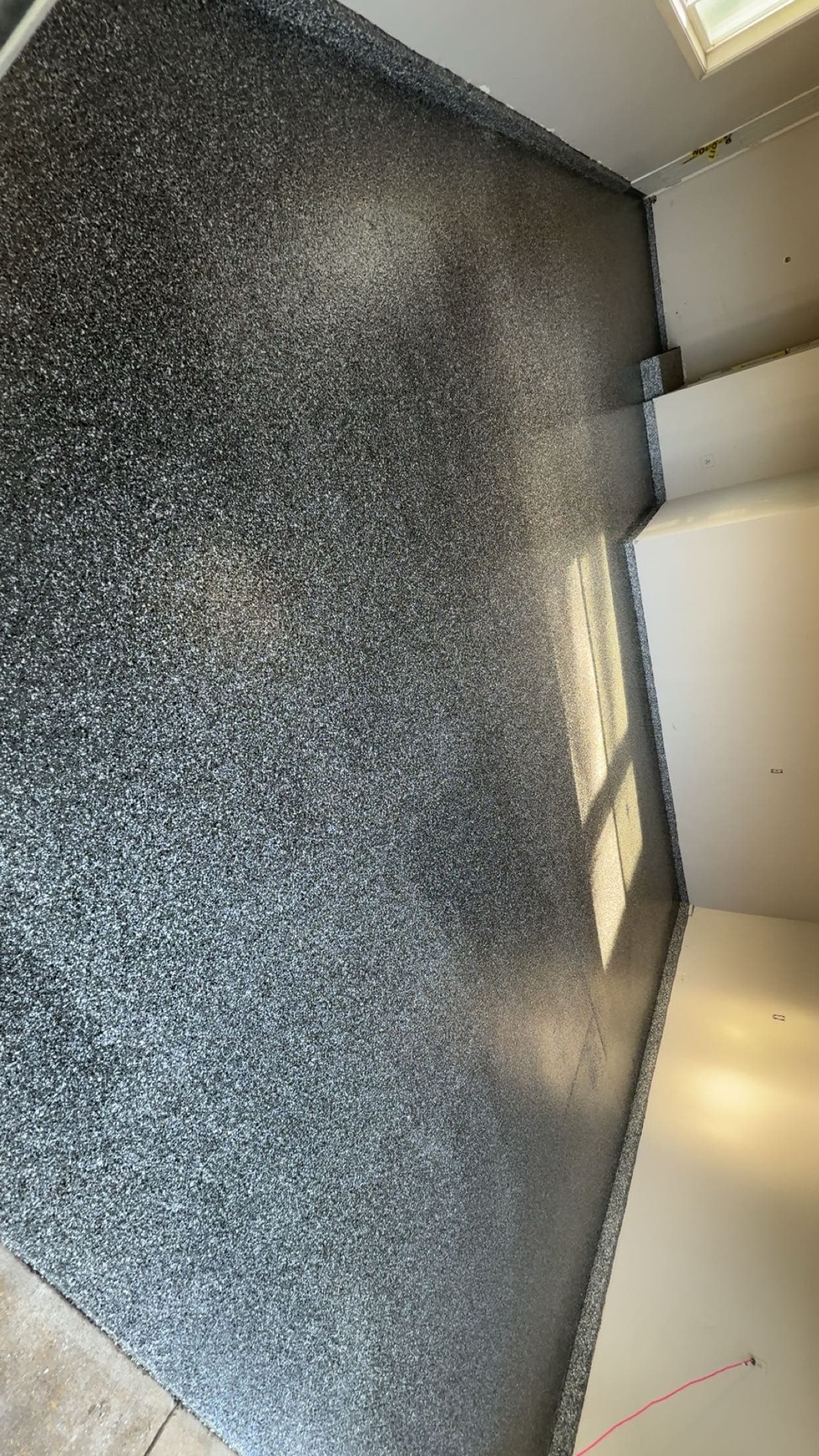
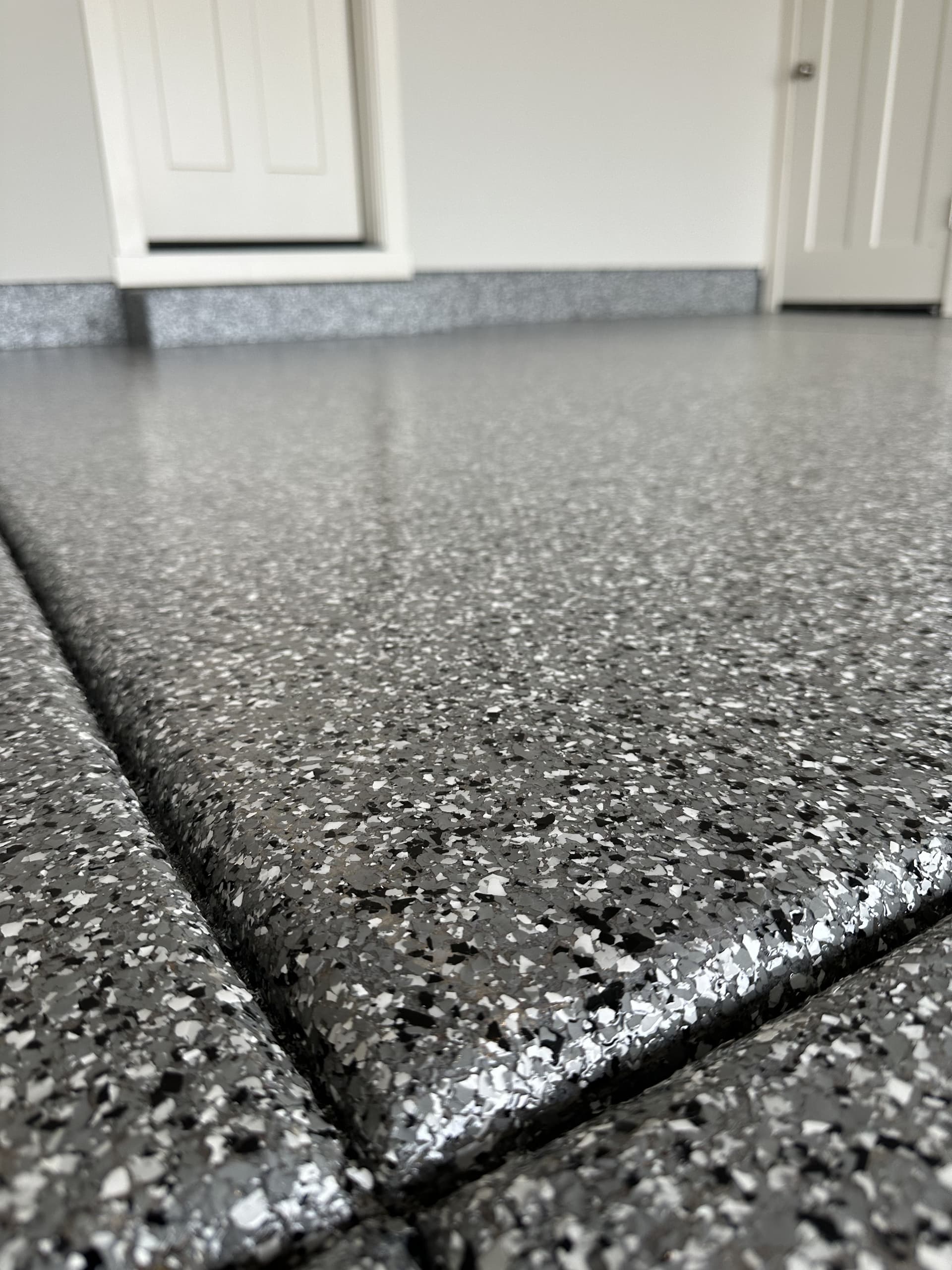
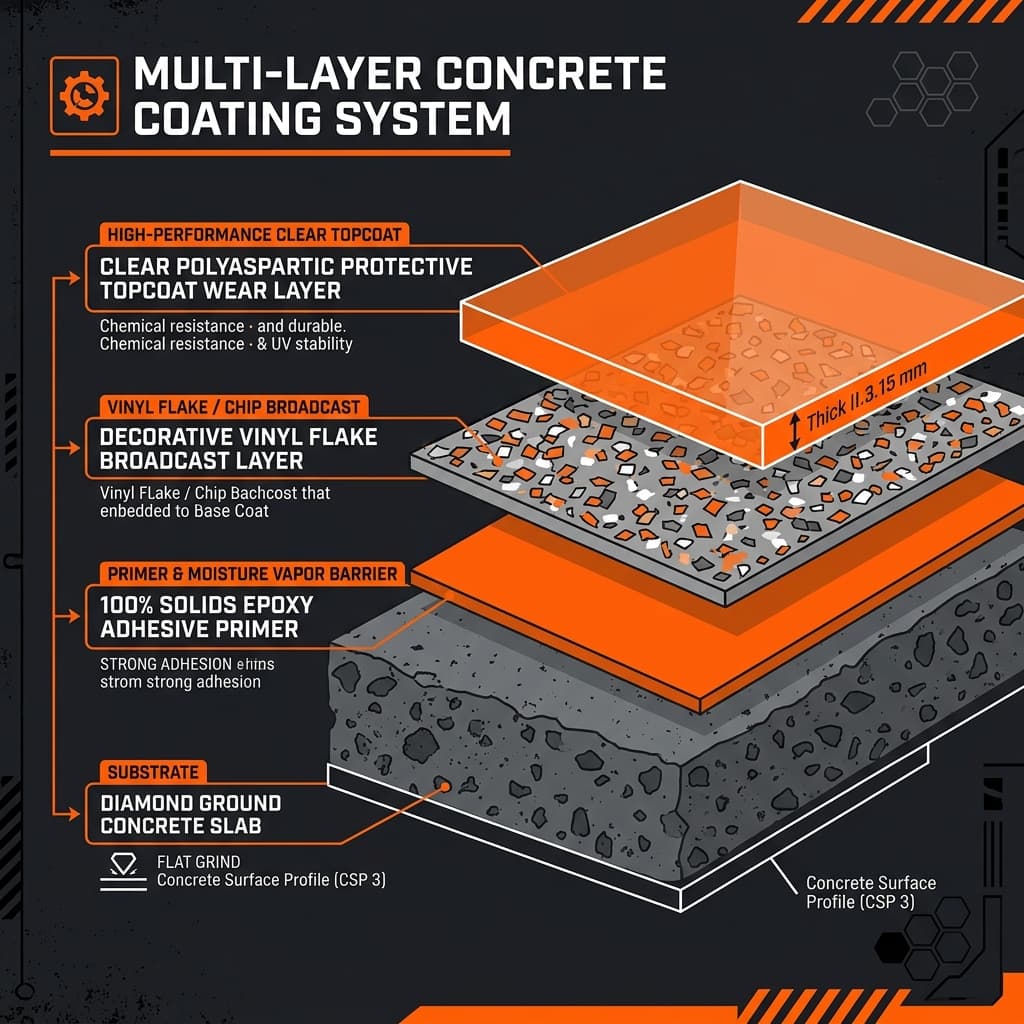
The highest-performing garage floor uses both resins together: a 100% solids epoxy basecoat to penetrate and anchor into concrete, and a clear polyaspartic topcoat for 100% UV stability and tire hot-pickup resistance.
Polyaspartic vs. Epoxy Is the Wrong Question
Almost every article on this topic frames the two resins as rivals, then declares a winner. That framing is wrong, and it leads homeowners to buy the wrong floor.
Epoxy and polyaspartic do different jobs. Epoxy is an adhesive-grade resin. Its strength is bonding to concrete. Polyaspartic is a wear-grade resin. Its strength is surviving what happens on top of the floor. A well-built garage system uses both, stacked in the right order.
The useful question is not which resin wins. It is what goes down against the slab, and what goes on top of it. That is the question this guide answers. If you want to see the finished system first, our full broadcast flake system is the exact stack described below.
What Each Resin Actually Is
Epoxy is a two-part thermoset. Part A is an epoxide resin, Part B is an amine hardener. Mixed, they crosslink into a rigid, tightly bonded film. A 100% solids epoxy contains no solvent or water carrier, so the wet film thickness you install is the cured film thickness you keep. Nothing flashes off and shrinks away. That matters, and it is the main reason big-box water-based kits underperform.
Polyaspartic is an aliphatic polyurea. It is produced by reacting an aliphatic polyisocyanate with a polyaspartic ester. That word aliphatic is the whole story on UV performance: aliphatic polymers have no aromatic ring in the backbone to absorb ultraviolet light and break down. Epoxy backbones are aromatic. They do absorb it, and they do break down.
One clarification worth making because the industry is sloppy about it. Polyaspartic is not one product. It is a family, and manufacturers tune the ester blend to control how fast it sets. Two coatings both labeled polyaspartic can behave very differently on a job site.
Cure Time and Pot Life: How a 1-Day Install Is Possible
Standard epoxy needs roughly 12 to 24 hours between coats and 3 to 7 days of chemical cure before it will take vehicle traffic without marring. That is a multi-day job with your garage out of commission the whole time.
Polyaspartic recoats in about 2 to 4 hours. That single property is what collapses a five-step floor system into one working day. Foot traffic returns the same day and vehicles go back on the floor at 24 hours.
There is a real tradeoff, and honest contractors will tell you about it. Polyaspartic pot life runs roughly 45 to 60 minutes at 77°F, and it shortens fast as temperature climbs. On a hot slab an installer may be working a 15 to 30 minute window. Once the material is mixed, the clock runs and it does not stop. Mis-time a batch and it kicks in the bucket. This is precisely why polyaspartic is not sold as a weekend DIY kit, and why crew experience matters more than the label on the pail.
UV Stability: Why Epoxy Ambers and Polyaspartic Does Not
Every epoxy ambers under ultraviolet light. Not the cheap ones. All of them. There is no epoxy floor coating on the market that stays color-stable in direct or strong indirect sunlight. It is a property of the chemistry, not a defect in the product.
In a garage this shows up as a stripe. The first three or four feet inside the door take the UV, and over a few years that band shifts yellow while the back of the garage stays true. You end up with a two-tone floor that no amount of cleaning fixes.
A common local misread: people assume the Pacific Northwest is safe from this because of the cloud cover. It is not. Diffuse ultraviolet passes through overcast skies at levels more than sufficient to degrade an aromatic resin. Grey days slow ambering down. They do not stop it.
Polyaspartic has no chromophore to degrade, so it holds color. The effect is most visible on light and neutral finishes, where a yellow shift reads immediately. If you are drawn to the lighter blends in our coating color catalog, a UV-stable topcoat is not an upgrade, it is a requirement.
Hot Tire Pickup, Hardness, and the "4x Harder" Myth
Hot tire pickup is the failure homeowners fear most, and it is widely misexplained. Here is the actual mechanism. Tires heat up in use and expand. Parked on a coated floor, a hot tire presses against the coating and its softened compounds grip it. As the tire cools it contracts, and that contraction pulls up on the film. If the bond to the concrete is weaker than that pull, the coating lifts off in patches shaped like tire contact patches.
Three things cause it. Inadequate surface profile, so the coating never got a real mechanical grip on the slab. Low-grade coating with poor heat tolerance, especially water-based kits, where tire heat can partially re-soften the film. And insufficient thickness, so there is not enough material to resist the load.
Note what is not on that list: hardness. You will see the claim that polyaspartic is "four times harder" than epoxy used as a closing argument. Treat it as marketing. Hardness is not the property that keeps a floor down. Bond strength, abrasion resistance, and thermal stability are. Polyaspartic wins on abrasion resistance and stays flexible enough to move with a slab that expands and contracts seasonally, while cured epoxy is comparatively rigid and more prone to cracking under that movement. Those are the real advantages. Hardness is the marketing one.
The full breakdown of what determines service life is in our guide on how long an epoxy garage floor actually lasts.
The Temperature Window: Why This Matters in an Oregon January
Epoxy cure slows sharply below about 55°F. In a cold garage it may take days longer than spec, and in bad conditions it can fail to fully crosslink at all, leaving a film that stays soft and never reaches its rated hardness or chemical resistance. That floor will look installed and behave like it is not.
Polyaspartic formulations tolerate a far wider application window, with some systems rated for use from well below freezing up to around 140°F. In practical terms, a polyaspartic topcoat lets a crew keep a schedule in an unheated garage in December instead of pushing the job to spring or renting heat.
For a shop in Woodburn or anywhere else in the valley, this is the difference between booking work year-round and losing four months of the calendar.
Amine Blush: The Oregon Humidity Failure Nobody Warns You About
This one deserves its own section because it is specific to our climate and it is invisible until it is expensive.
Amine blush is a side reaction. The amine hardener in curing epoxy reacts with atmospheric moisture and carbon dioxide, forming a waxy carbamate film on the surface. It is triggered by exactly one combination: low temperature plus high humidity. That is a Willamette Valley November in a single sentence.
The consequences stack up. Blushed epoxy shows increased tendency to yellow, reduced gloss retention, lower stain and chemical resistance, and surface softening. Worst of all, that waxy layer is a bond breaker. Topcoat applied over unremoved blush does not adhere to the basecoat, and the floor delaminates between layers months later. From above, the failure looks identical to a bad slab bond. It is not. It was a scheduling and process error.
It is preventable through product selection, humidity and temperature control during cure, and washing the blush off before recoating. It is only preventable if the crew knows to look for it. Our prep and moisture testing process treats ambient conditions as a go or no-go decision, not a footnote.
The System FlowSeal Installs
Every residential floor we install follows the same sequence, because the sequence is what produces the result.
First, electronic moisture testing and a slab condition assessment. Second, industrial diamond grinding to open the concrete to a CSP 2 to 3 profile, with crack and joint repair as needed. Third, a 100% solids epoxy or vapor-barrier primer that penetrates the open profile and locks into the slab. Fourth, a pigmented epoxy basecoat with vinyl flake broadcast to rejection. Fifth, scrape and vacuum the excess flake. Sixth, a UV-stable polyaspartic clear topcoat.
That fourth step is where the finish gets decided, and it is worth understanding the tradeoff between flake and solid color before you pick.
Epoxy against the concrete because it bonds. Polyaspartic on top because it wears. That is the entire argument, and it is why the versus framing misses the point.
The same logic scales up and sideways. Our metallic epoxy systems use the same UV-stable topcoat over a decorative resin field, our polished concrete skips the coating entirely for spaces that want the slab itself, and our commercial and industrial coatings build heavier film for forklift and chemical exposure.
When One Resin Alone Makes Sense
There are legitimate cases for a single-resin floor, and pretending otherwise would be dishonest.
Polyaspartic direct to concrete works for fast-turnaround commercial jobs where the facility cannot close, for cold-weather installs outside epoxy’s window, and for thin-film applications where high build is not the goal.
Epoxy alone is defensible in fully interior spaces with zero UV exposure, in high-build or self-leveling applications where thickness is the requirement, and where budget genuinely governs. A basement with no windows will not amber.
Anywhere sunlight reaches the floor, or vehicles park on it, the hybrid system is the correct answer. If you are not sure which category your space falls into, request a free onsite assessment and we will tell you which one you need, including when the cheaper option is the right one.