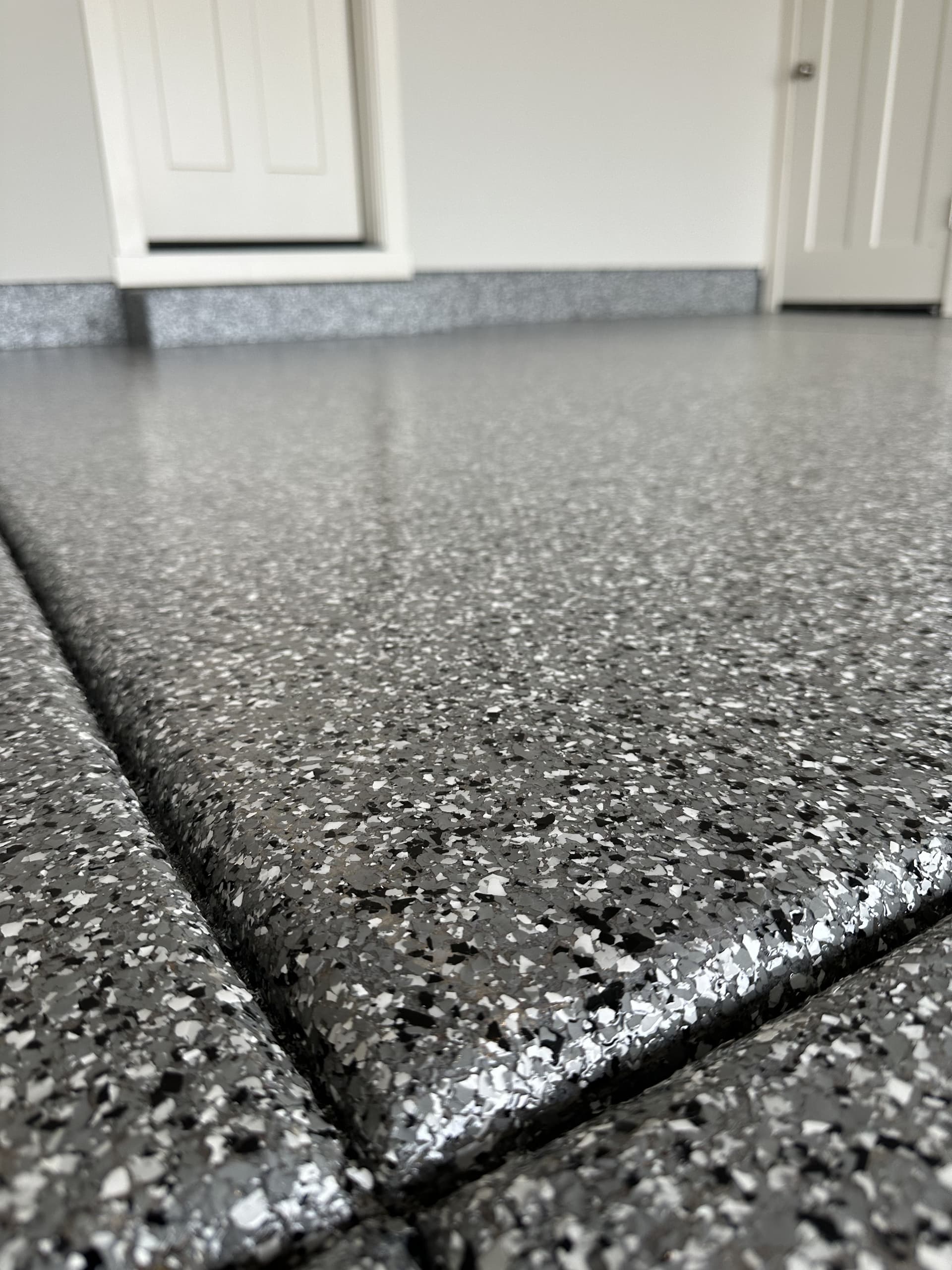
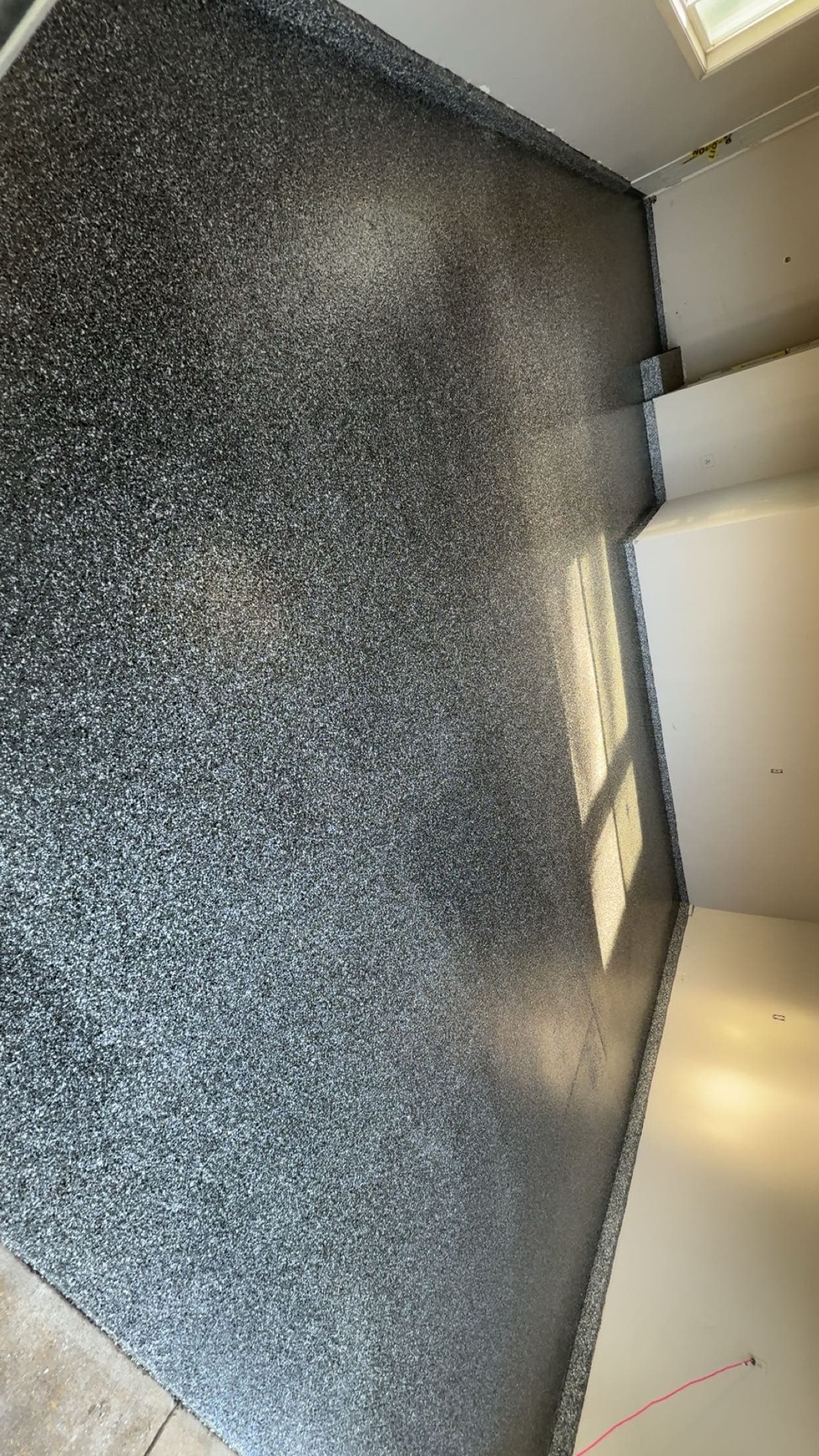
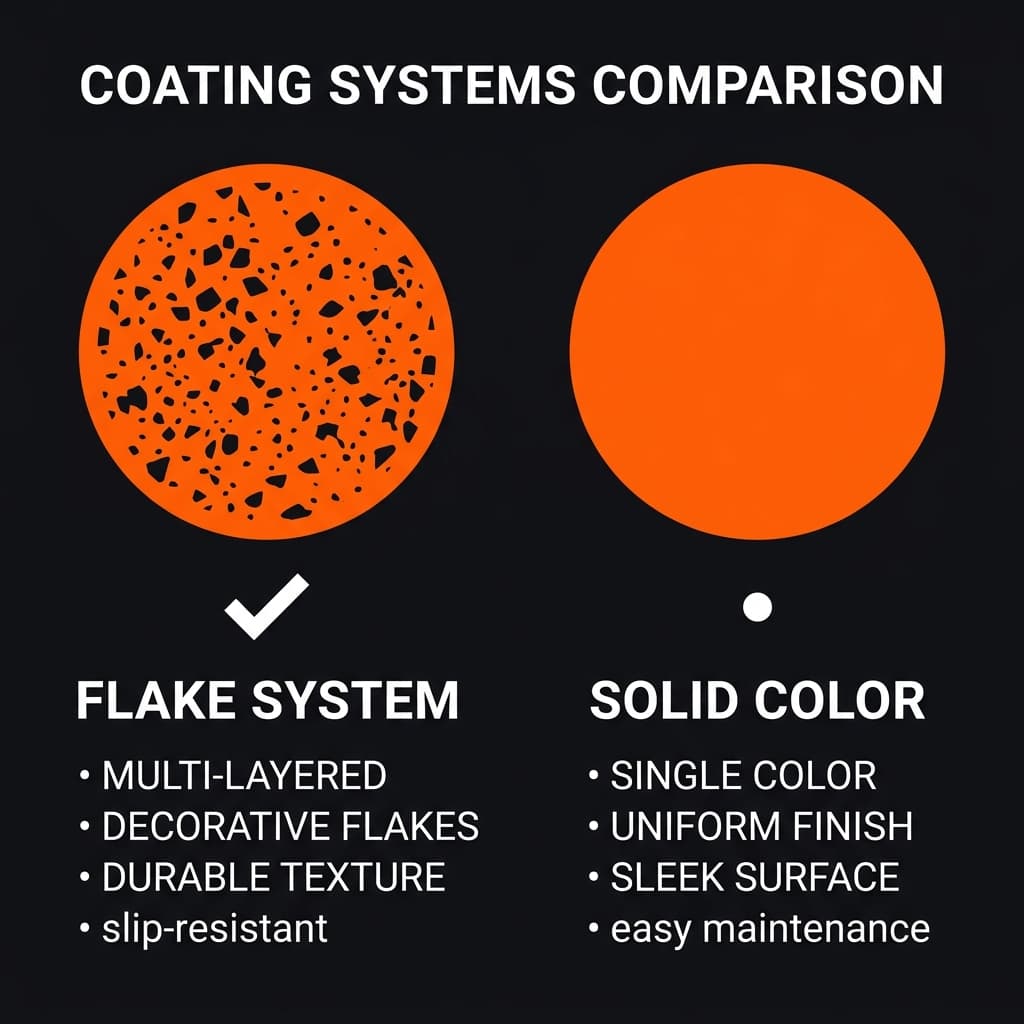
Flake hides wear far better than solid color. A multi-tone flake blend breaks up the visual field so tire marks, dust, oil, and small chips have no uniform background to contrast against, while solid color creates a perfectly uniform surface that makes every scuff visible. Flake also provides built-in slip resistance from its orange-peel texture and builds a thicker floor, because the chip layer adds film thickness. Solid color remains the right choice for warehouses needing line striping, washdown hygiene environments, and decorative metallic floors where a smooth field is the point.
Two Finishes, Two Very Different Surfaces
A solid color floor is a monolithic pigmented film. One color, edge to edge, smooth and uniform, usually finished to high gloss. It reads clean and modern the day it is installed.
A flake floor is built differently. A pigmented basecoat goes down, colored vinyl chips are broadcast into it while it is wet, the excess is scraped and vacuumed once cured, and a clear topcoat locks the whole layer in. The result is multi-toned and lightly textured.
Here is the part that surprises people: these are often the same resin chemistry. The difference is not what the floor is made of. It is how the surface is structured, and that structure drives nearly everything you will care about over the next fifteen years. Both are covered in our service overview, and the color catalog shows what each looks like installed.
Hiding Wear: The Honest Comparison
Solid color is gorgeous on day one and unforgiving on day one hundred. Because the field is uniform, your eye has a perfect reference against which to notice every deviation. Tire scuffs, hairline scratches, settled dust, a dropped-wrench chip, the faint sheen difference where you always walk. All of it registers.
The color choice does not rescue you, it only changes which problem you get. Dark solids show dust and lint constantly. Light solids show tire marks, oil, and rust. There is no solid color that hides both.
A flake blend breaks the visual field into thousands of small tonal variations. There is no uniform reference, so minor imperfections have nothing to contrast against and simply disappear into the pattern. A multi-color flake floor conceals tire marks, oil spots, and small chips better than any solid coating, and it does so passively, without you doing anything.
This is the single biggest reason flake dominates residential garages. It is not aesthetics. It is that a working garage never stays pristine, and flake is the finish that does not punish you for that.
Slip Resistance: Traction You Get for Free
When flakes settle into a wet basecoat they land at varied angles and heights. The clear topcoat conforms over them rather than burying them flat, producing a subtle orange-peel texture across the whole floor.
That texture is functional. It provides meaningful traction underfoot, and in Oregon that is not a small detail. From October through May you are tracking rain in on boots and parking wet tires indoors. A garage floor is a wet floor here for more than half the year.
High-gloss solid color, by contrast, is genuinely slick when wet. Making it safe requires broadcasting an aggregate additive such as aluminum oxide or polymer grit into the topcoat. That works, but it introduces a tradeoff: the grit creates open texture that traps dirt and makes the floor harder to clean. You solve traction and inherit a cleaning problem.
Flake gets its traction from the structure of the finish itself rather than from an additive. You get the grip without the cleanability penalty. For facilities with formal safety requirements, our commercial and industrial systems spec anti-slip texture and safety striping to match the operating environment.
Full Broadcast vs. Partial Broadcast: Where the Price Gap Hides
This is the most important thing in this guide and the least discussed. Two flake floors quoted at very different prices are frequently not the same product.
Partial broadcast scatters chips across the basecoat so the basecoat color still shows between them. It uses far less flake, costs less, and builds a thinner floor.
Full broadcast to rejection means chips are applied continuously until the coating physically cannot absorb any more and the surface is no longer wet anywhere. The floor is then scraped and vacuumed and topcoated. Coverage rates tell the story: roughly 6 to 8 square feet per pound with 1/4 inch flakes, and 5 to 7 square feet per pound with 1/8 inch flakes. On a full broadcast that lands around 0.10 pounds per square foot for 1/4 inch chips and can approach 0.20 pounds per square foot for finer blends.
Why it matters beyond appearance: at full broadcast the chip layer itself becomes part of the film build and functions as a wear course. Partial broadcast floors have thinner protection in the traffic lanes, and over time they wear through to expose the basecoat color in exactly the paths you drive and walk. The floor does not fail, it just stops looking like the floor you bought.
When you compare bids, ask every contractor whether they are quoting full broadcast to rejection or partial coverage. A large share of the price difference between quotes lives in that answer. Our flake system is full broadcast on every residential installation.
Flake Size Changes Both the Look and the Feel
Chip size is a real specification, not a detail. It changes appearance at a distance and texture underfoot.
1/8 inch chips produce a tighter, finer, more uniform field. From standing height the floor reads closer to a solid color with depth in it, and the surface feels smoother. It suits interiors, basements, and anyone who wants subtle rather than bold.
1/4 inch chips give more contrast, more visible pattern, and more pronounced texture. This is the standard for garages and the size most people picture when they imagine a flake floor. It hides the most and grips the best.
Larger 1 inch chips make a deliberate high-contrast statement and are usually reserved for interior feature spaces. Browse installed examples by blend in the full coating catalog.
Where Solid Color Is Still the Right Answer
Flake is not the universal winner, and there are four situations where solid color is clearly correct.
Line striping and safety markings. You cannot cleanly apply crisp striping, traffic lanes, or OSHA safety markings over a textured multi-tone surface. Warehouses, hangars, and manufacturing floors that need marked walkways and equipment zones want a solid field to mark against.
Washdown and hygiene environments. A smooth, seamless, non-porous solid surface squeegees clean and is easier to sanitize than any textured finish. Food handling and clinical spaces default to solid for this reason.
Decorative resin work. In a metallic epoxy floor the smooth field is the entire point, because the visual interest comes from pigment movement within the resin rather than from broadcast media.
Large-square-footage cost control. Across tens of thousands of square feet, the flake material and labor delta is a genuine budget line. Our commercial coating systems are frequently specified as solid color for exactly this reason.
Maintenance: Same Cleaning, Different Results
Both finishes are non-porous and seamless, and both are cleaned the same way. Dust mop regularly to lift grit before it can scuff the topcoat, then wet mop with a neutral pH cleaner and warm water. Skip harsh acids, citrus-based cleaners, and abrasive solvents on either surface.
The difference is not how you clean them. It is how long they look clean afterward. A solid floor looks flawless right after you mop and starts visibly declining almost immediately. A flake floor looks essentially the same on day one and day nine.
For high-traffic and commercial environments, the full protocol including scrubber selection and spill response is in our commercial floor care guide.
How to Choose in Thirty Seconds
Residential garage, workshop, or basement, where the floor will be used rather than displayed: full broadcast flake. It hides wear, grips when wet, and builds a thicker floor.
Warehouse or facility needing striping, markings, or washdown hygiene: solid color, with an anti-slip additive where traction is required.
Showroom, retail, or luxury interior where the floor is the feature: metallic epoxy.
Modern interior living space where you want the concrete itself: polished concrete.
Still deciding, or your slab has cracks, moisture, or previous coating on it? That changes the recommendation. Book a free onsite estimate with a moisture test and square footage measurement, and we will spec the system your slab actually calls for.